Transferring articulated motion from monocular videos to rigged 3D characters is challenging due to pose ambiguity in 2D observations and morphological differences between source and target. Existing approaches follow a reconstruct-then-retarget paradigm, tying transfer quality to intermediate 3D reconstruction and limiting applicability to categories with parametric templates, such as humans and quadrupeds.
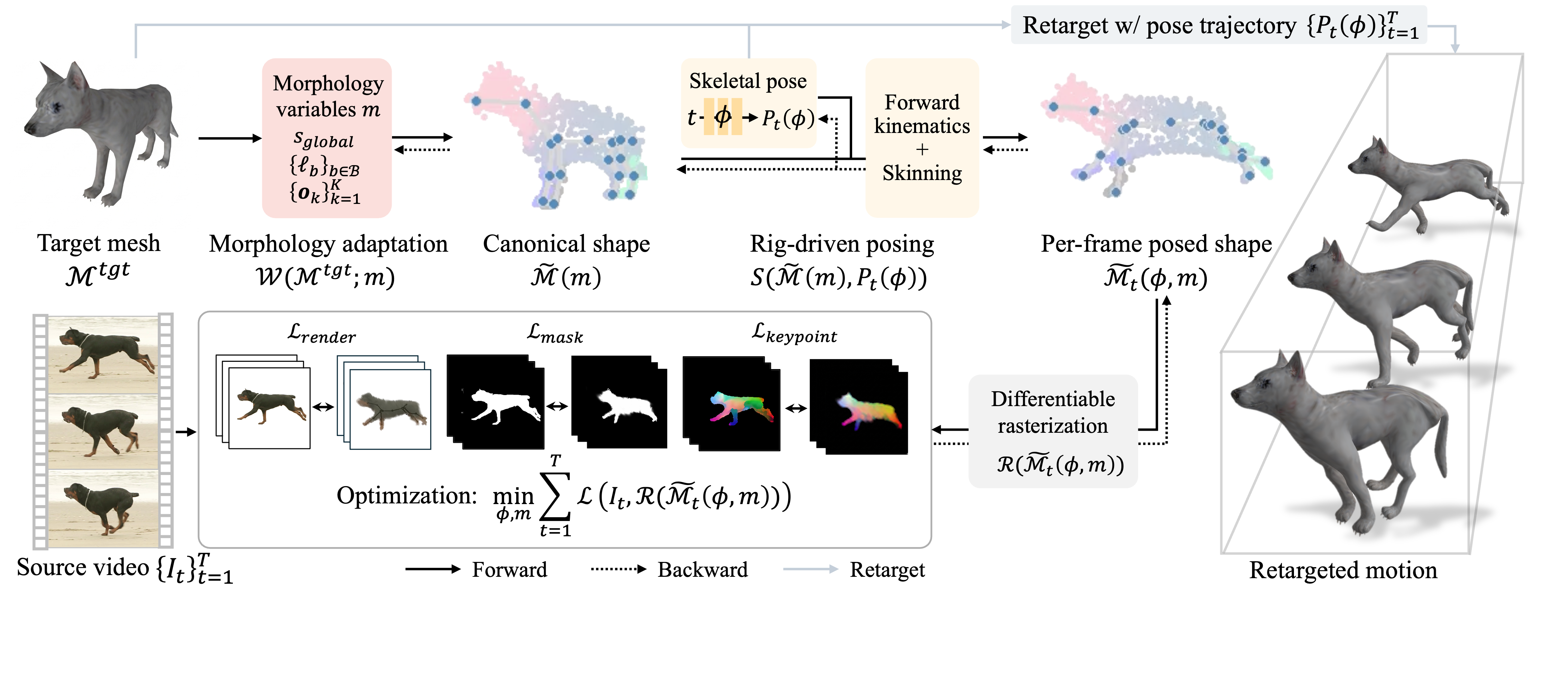
We propose MorphGS, a framework that formulates motion retargeting as a target-driven analysis-by-synthesis problem: instead of reconstructing the source in 3D, we directly optimize the target character's morphology and pose through image-space supervision via differentiable Gaussian rendering. A rig-coupled morphology parameterization factorizes time-invariant character identity from time-varying joint rotations, while dense 2D–3D correspondences and synthesized views provide complementary structural and multi-view guidance.
MorphGS requires no parametric templates, no motion priors, and no category-specific training, and consistently outperforms baselines on synthetic benchmarks (Mixamo, DT4D) and real-world videos.
Given a source video and a rigged target character, MorphGS represents the target as morphology-adaptive articulated 3D Gaussians: primitives are initialized from the mesh vertices and inherit skinning weights directly from the rig, while morphology is controlled by three structured parameters — global scale, learnable bone lengths, and skeleton-anchored rest-pose offsets. Because all shape changes are time-invariant and coupled to the rig, they cannot silently absorb per-frame pose errors, mitigating the shape–pose ambiguity of monocular optimization.
A time-conditioned pose network predicts per-frame joint rotations and root motion, which pose the Gaussians via forward kinematics and linear blend skinning. Differentiable rasterization closes the loop: image-space gradients flow back to both morphology and pose, so the target itself deforms to explain the video. Rendering losses are complemented by dense 2D–3D correspondence keypoints (part-level anchoring) and synthesized views (multi-view constraints under self-occlusion).
A staged schedule first resolves global alignment, then bone lengths and joint rotations, and finally all parameters jointly — about 5 minutes per scene on a single RTX 4090. Once complete, only the recovered pose trajectory is applied back to the target rig, preserving its original geometry.
We present motion transfer comparisons on synthetic benchmarks (Mixamo, DT4D) and real-world videos (DAVIS), spanning humanoids, quadrupeds, and non-quadruped animals. MorphGS consistently outperforms reconstruct-then-retarget baselines in both geometric accuracy (PMD) and perceptual motion fidelity (FVMD) across all benchmarks, while preserving the target's original mesh structure.
@inproceedings{kim2026morphgs,
title = {MorphGS: Morphology-Adaptive Articulated 3D Motion Transfer from Videos},
author = {Kim, Taeyeon and Na, Youngju and Lee, Jumin and Lee, Sebin and Sung, Minhyuk and Yoon, Sung-Eui},
booktitle = {European Conference on Computer Vision},
year = {2026}
}